After the bright lights and larger-than-life attractions of Pigeon Forge, I headed west toward Knoxville—and what a wonderfully warm and welcoming town this turned out to be! Knoxville has that lovely combination of history, culture, beautiful scenery, and people who make you feel right at home. It was time to trade the tourist attractions for a little art and local flavor. And, as it turns out, Knoxville had plenty of both.
A Small Museum with a Mighty Big Impression
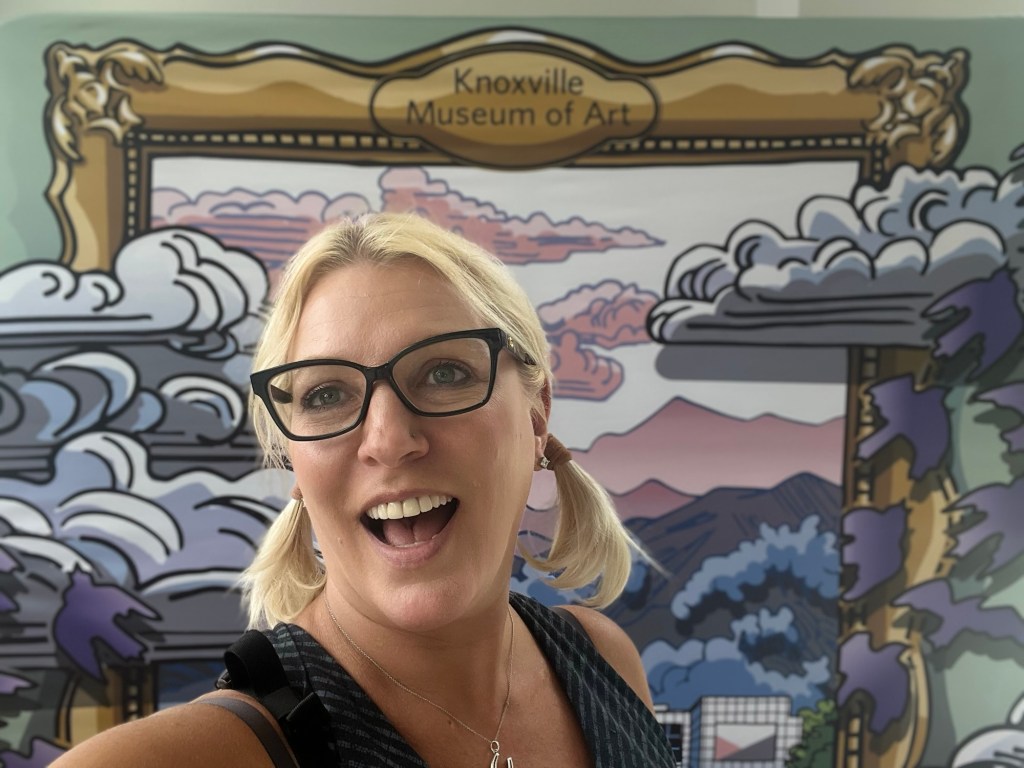
My first stop was the Knoxville Museum of Art, and wow! I was genuinely impressed by this small-but-mighty collection. Sometimes the best museums aren’t the biggest ones; they’re the ones that surprise you with something you didn’t know you needed to see.
One piece that stopped me in my tracks was Ansel Adams’ Dawn, Autumn Forest, featuring the Great Smoky Mountains. The accompanying plaque explained how challenging it was for Adams to photograph the scenery. I can see why. The Smokies are, well, smoky and mysterious. (Insert chuckle at my own joke here.)
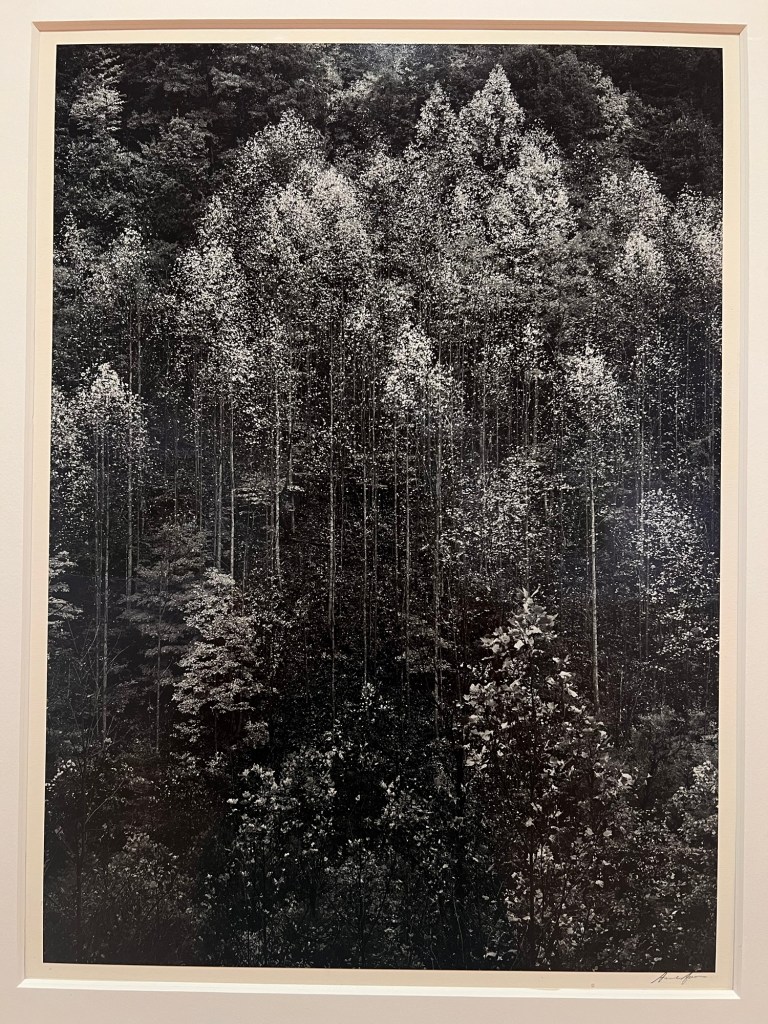
The region is breathtakingly beautiful, but capturing that beauty must be a photographer’s challenge. Between the humidity, atmospheric haze, and ever-changing mountain light, the landscape can seem to disappear behind a soft veil. It’s one thing to stand there and admire it; it’s another to make a photograph that conveys what you’re seeing. And Adams did what Ansel Adams does: he made it look extraordinary.
I also learned about the Knoxville 7, a group of seven artists who helped bring modernism to East Tennessee during the 1950s and 1960s. Led by C. Kermit “Buck” Ewing, who came to Knoxville to head the University of Tennessee’s art department, the group included Carl Sublett, Holly Stevens, Robert Birdwell, Joanna Higgs, Richard Clarke, and sculptor Philip Nichols.
These artists were experimenting with contemporary styles at a time when traditional approaches still dominated much of the local art scene. Their work introduced some of the first abstract art in East Tennessee and helped give the region a fresh artistic voice. They didn’t all work in the same style, either. Some explored city scenes and the human figure, others interpreted landscapes in new ways, and Nichols brought his industrial welding skills into sculpture.
In other words, they weren’t simply making art. They were helping change what art could look like in East Tennessee. I love discovering these little pockets of history—especially the people who quietly, or not so quietly, change the direction of a community.
A World’s Fair, a Fountain, and a Golden Ball in the Sky
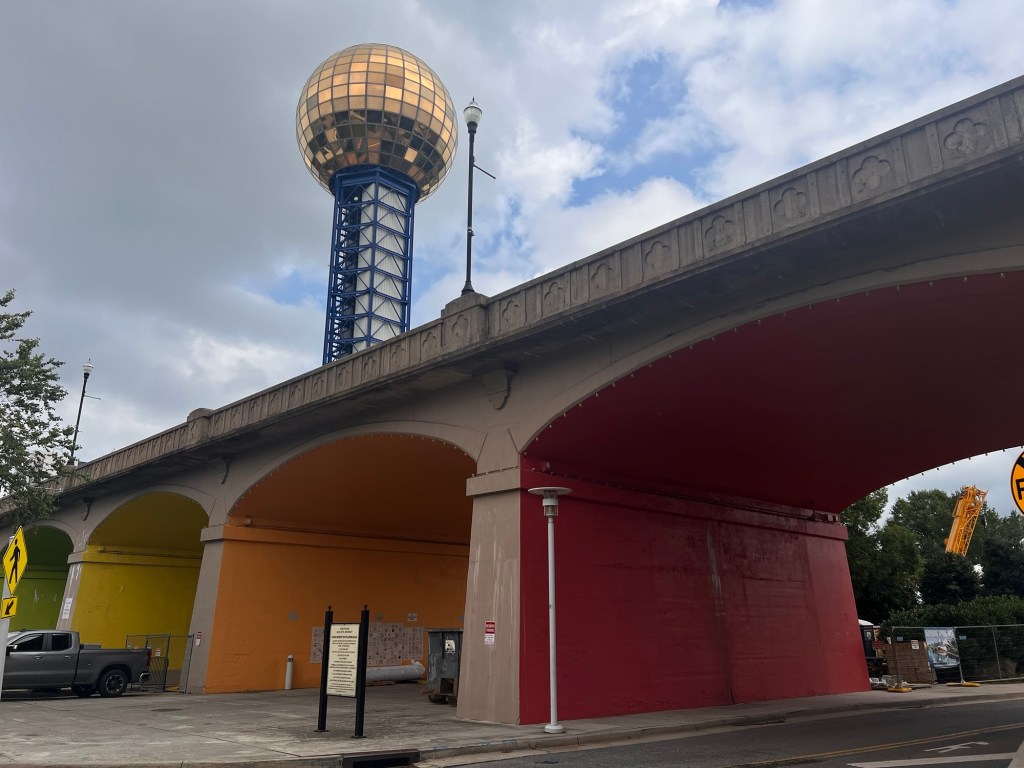
From the museum, I wandered over to World’s Fair Park. The fountain, the open green space, and that magnificent Sunsphere made for one gorgeous afternoon. I found myself gazing up at the golden globe and thinking that Knoxville certainly knows how to make an entrance.
The Sunsphere was built for the 1982 World’s Fair, whose theme was “Energy Turns the World.” Standing 266 feet tall, it became the fair’s unmistakable symbol. Its golden sphere is five stories high, and its glass panels are made with 24-karat gold. Because apparently an ordinary observation tower simply wouldn’t do.
The fair welcomed more than 11 million visitors to Knoxville in 1982, and it was considered the last successful World’s Fair held in the United States. Not bad for a city that had initially been dismissed by some critics as a “scruffy little city.” Knoxville eventually embraced the nickname, and the fair proved the skeptics wrong. I love a good underdog story!
The Sunsphere and Tennessee Amphitheater are the two original structures that remain from the fair. Today, the observation deck offers sweeping views of downtown, the Tennessee River, the University of Tennessee, and—appropriately—the Great Smoky Mountains.
Market Square: Knoxville’s Outdoor Living Room
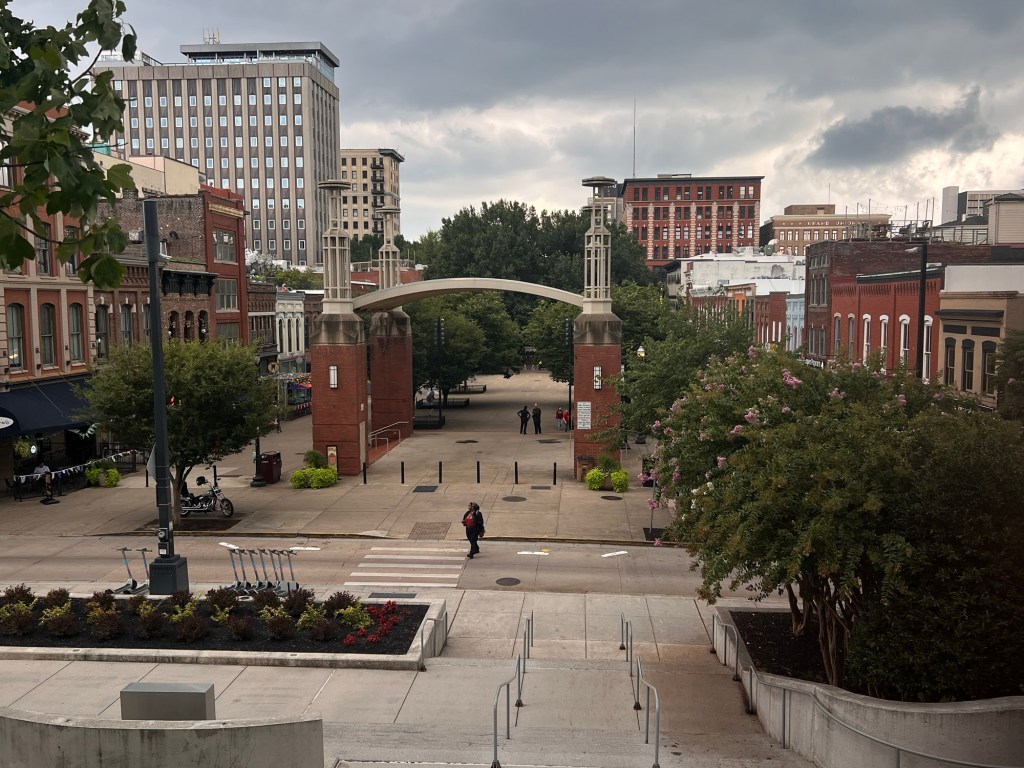
After checking into my hotel, I headed out to explore Market Square and find something to eat. The area has such a welcoming, lively feel. Restaurants, shops, people strolling around, and that unmistakable sense that this is where the community comes together.
And it turns out Market Square has been doing exactly that for a very long time.
Its origins date to 1854, when two local civic leaders, William G. Swan and Joseph A. Mabry, donated land to the city for a public market. Their goal was to give local farmers a permanent place to bring their goods and sell directly to city residents. They even dedicated the space as a market for farmers forever. Before that, Knoxville’s public markets moved from place to place, which wasn’t particularly convenient for shoppers or vendors.
The original Market House was built that same year, and the square became an important center of commerce and civic life. Over time, it evolved from a place to buy produce and provisions into the lively downtown gathering place it is today. The market may look a little different now, but the idea of bringing people together hasn’t changed much.
And what better way to participate in local culture than to have ice cream for dinner?
I decided that the only reasonable thing to do when in Knoxville was to visit Cruze Farm Dairy. I ordered a chocolate-dipped cone, and it was every bit as delicious as I hoped. The chocolate coating, the creamy ice cream, the whole experience—perfection.
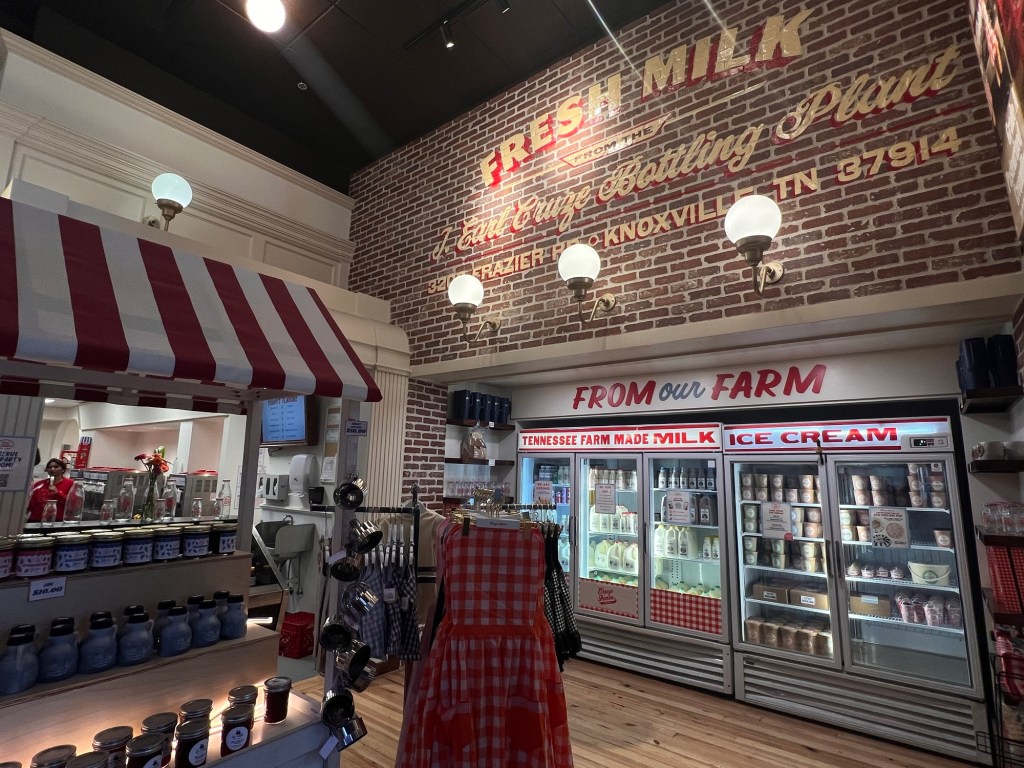
Cruze Farm is a family dairy that began in 1980 with Earl and Cheri Cruze. Earl was a fourth-generation dairy farmer, and the family eventually turned their farm-fresh milk into the ice cream and dairy business locals enjoy today. Their story is a sweet reminder that sometimes the best local treasures grow from a family passion and a whole lot of hard work.
I went to bed happy, full of ice cream, and completely content with my Knoxville evening. Dinner reservations? No. Dessert? Absolutely. Priorities.
Peyton Manning Pass and a Little Volunteer Spirit
The next morning, before leaving town, I had one more Knoxville stop to make: the University of Tennessee.
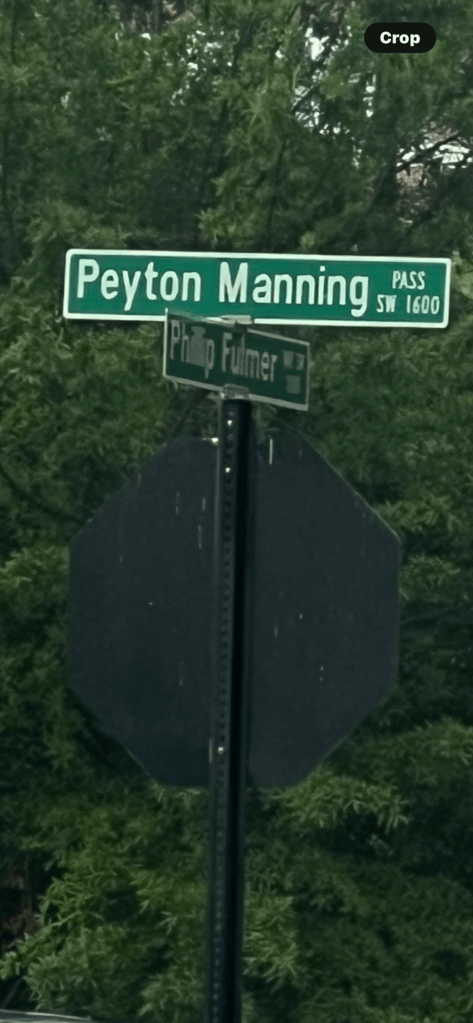
Of course, I had to drive down Peyton Manning Pass. He is, after all, the second-best Manning of all time. I’m just saying, if you beat the G.O.A.T. not once but twice, doesn’t that make you the G.O.A.T.? I’m no football aficionado, but the math seems pretty convincing to me.
Peyton Manning Pass runs from Volunteer Boulevard toward Neyland Stadium and is part of the route used for the famous Vol Walk. On football Saturdays, fans line the road to cheer on the Tennessee team as the players make their way into the stadium.
Even if you’re not a football fanatic, it’s hard not to appreciate the tradition and enthusiasm surrounding this university. Knoxville takes its Volunteers seriously, and I was happy to get a little taste of that spirit before hitting the road.
Ozone Falls: Nature’s Version of a Grand Finale
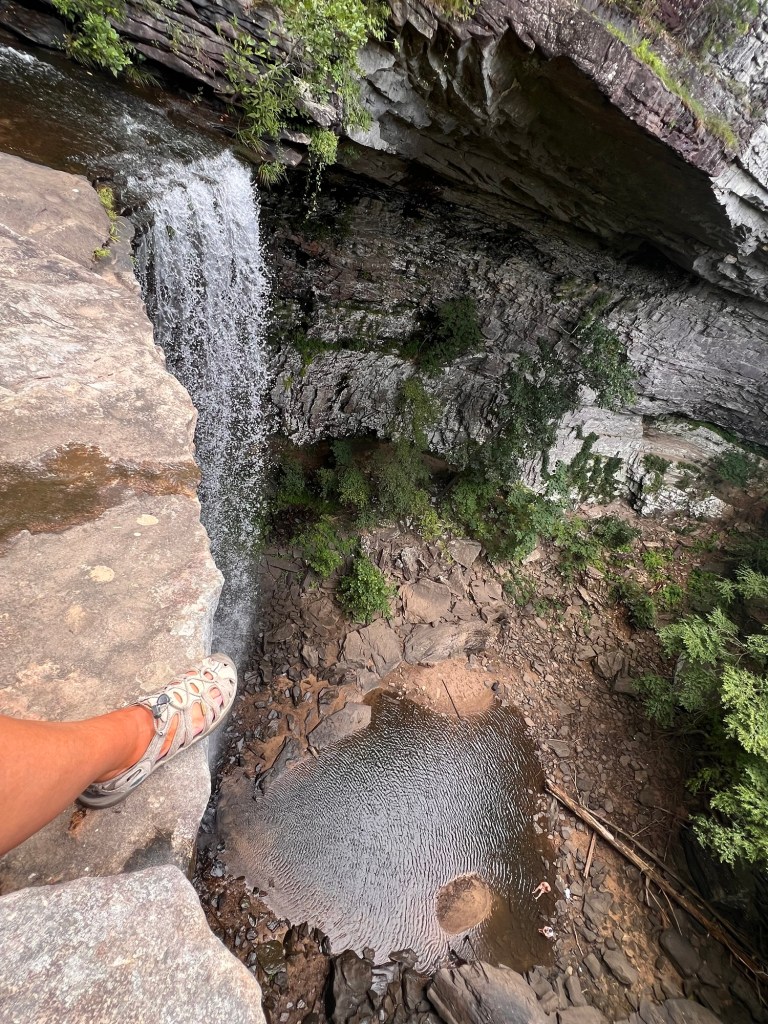
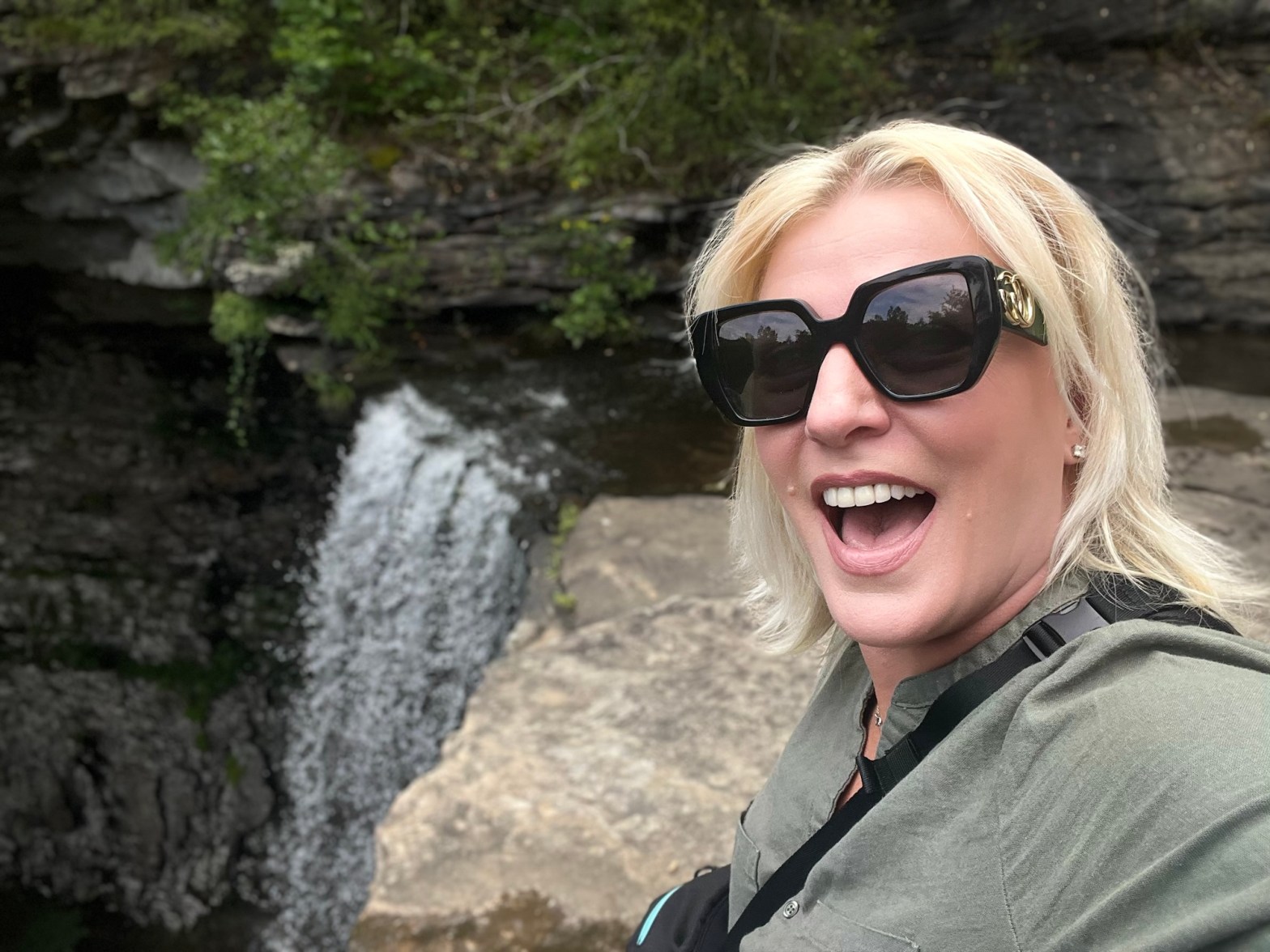
I had one last pit stop before making my way to Nashville, and it turned out to be one of the most spectacular surprises of the entire trip: Ozone Falls State Natural Area.
WOW.
I parked near the sign and made my way along the short trail toward the falls. I was expecting something pretty. I was not expecting to be standing so close to a waterfall that seemed to command the entire landscape.
Ozone Falls plunges about 110 feet over a ledge into a deep, rocky pool below. The water has carved out a dramatic natural rock amphitheater, making the whole scene feel almost otherworldly. The mist, the sound of the rushing water, the enormous rock formations—it’s the kind of place that makes you stop talking for a minute and just take it all in.
And by “take it all in,” I mean I also had a moment of realizing just how close I was to a very long drop.
There isn’t a guardrail protecting every viewpoint, and I am not going to pretend that didn’t give me a touch of vertigo. I stood there appreciating the view while simultaneously imagining all the ways gravity could ruin my afternoon. It’s amazing how quickly breathtaking scenery can turn into a personal risk assessment.
But the beauty! Being able to experience a waterfall so close, hear its power, and see the landscape that water has shaped over time was absolutely incredible. It was a little terrifying, a whole lot exhilarating, and completely worth the stop. Just remember that the rocks can be slippery, and the edge deserves plenty of respect.
A quick fun fact: the name “Ozone” reportedly came from the fresh, stimulating quality of the air created by the waterfall’s mist.
From Waterfalls to Honky-Tonks
And just like that, my time exploring rural Tennessee was coming to an end.
Knoxville had given me art, history, a beautiful downtown, a golden sphere in the sky, a chocolate-dipped ice cream cone, a little football fandom, and one unforgettable waterfall. It was a wonderful reminder that some of the best travel experiences come from mixing the planned stops with a few unexpected discoveries.
I left feeling grateful for the warmth of the town and the incredible variety of places I’d experienced along the way. Tennessee had shown me mountain views, historic towns, music, art, and some pretty spectacular natural beauty.
But now it was time to trade the waterfalls and winding country roads for neon lights, live music, and a little honky-tonk mischief.
Next stop: Nashville!
And if the rest of this road trip has taught me anything, it’s that I should probably never say no to an adventure—or an ice cream dinner.


Your descriptions and back history on places makes my easy chair travels so nice. Your words come together like a good painting that I’m able to view at last. Thank you. Keep traveling and I’ll tag along.
LikeLiked by 1 person